
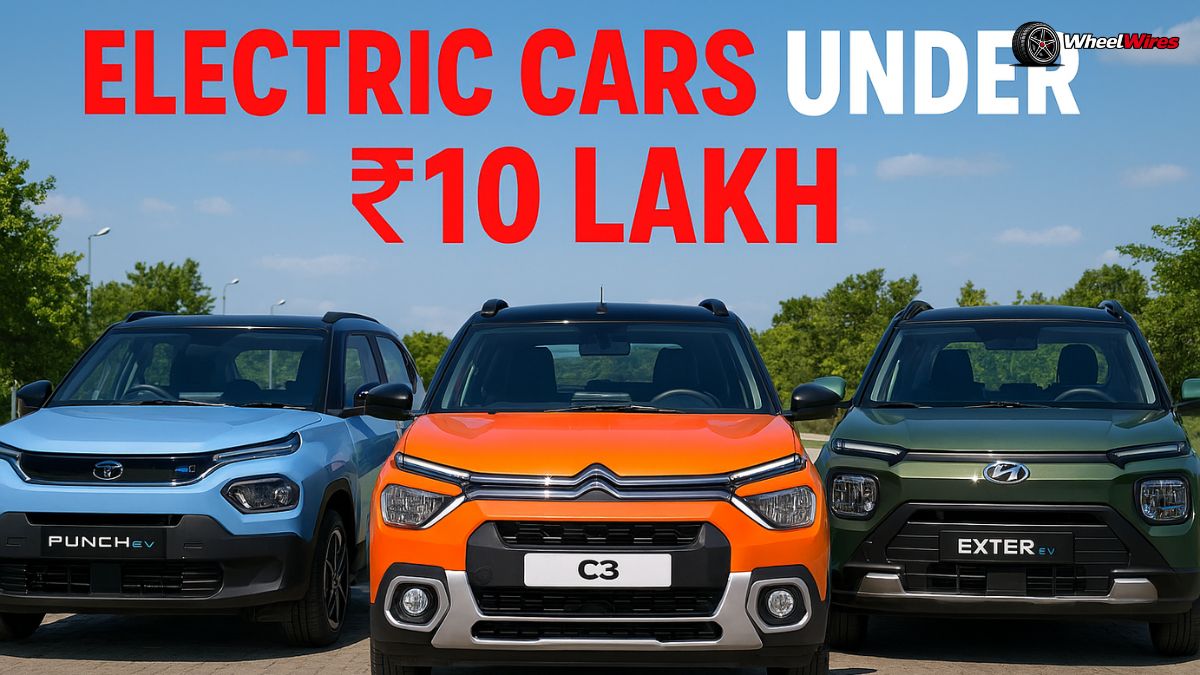
Electric Cars Under 10 Lakh in India: The Affordable EV Boom is Here The electric vehicle landscape in India has transformed dramatically by 2026. What was once a niche segment is now a thriving marketplace, especially in the affordable category. With increased local manufacturing of batteries, expanded charging infrastructure under government schemes, and fierce competition, the sub-₹10 lakh EV segment now offers impressive options that combine range, features, and practicality.
If you’re looking to make the switch to electric in 2026 with a budget of ₹10 lakh, you’re in for a pleasant surprise. Here are the Electric Cars Under 10 Lakh in India that deliver exceptional value, advanced technology, and peace of mind. Here a Full List of Electric Cars Under 10 Lakh in India
1. Tata Punch EV
Starting Price (ex-showroom): ₹9.99 Lakh
Building on the massive success of its ICE version, the Tata Punch EV has become the default choice for Indians seeking an electric SUV experience on a budget. By 2026, Tata has introduced a more affordable base variant specifically to dominate the sub-₹10 lakh space, without significant compromises.
Key Highlights
Range & Battery: Features a new, cost-optimized LFP (Lithium Iron Phosphate) battery pack of 22 kWh, offering a certified MIDC range of 285 km. Real-world city range is a practical 230-250 km.
Performance: A dedicated 70 kW (95 hp) motor powers the front wheels, delivering a 0-60 km/h time of 5.2 seconds, making it perfect for city and highway merging.
2026 Features: Even the base variant now includes a 10.25-inch touchscreen with wireless Android Auto & Apple CarPlay, a 4-speaker Harman audio system, and OTA (Over-The-Air) update capability. The iconic SUV design with 187 mm ground clearance remains.
Safety & Platform: Built on Tata’s pure EV Acti.EV platform, it boasts a 5-star BNCAP safety rating (achieved in 2024). Standard safety includes dual airbags, ABS, EBD, ESC, and rear parking camera with sensors.
Why it Tops the List in 2026: It offers the perfect blend of SUV appeal, trusted Tata Motors safety, a future-proof EV-only platform, and features that feel premium for the price. The extensive service network is a huge plus.
ALSO READ: Toyota Urban Cruiser Ebella Revealed In India with 543 km range
2. Citroen EC3
Starting Price (ex-showroom): ₹9.49 Lakh
Citroën has aggressively positioned the eC3 as the value-for-money leader. By 2026, the car has received a subtle refresh with updated features () and continues to benefit from attractive corporate and finance offers, making its effective on-road price highly competitive in many states.
Key Highlights
Range & Battery: Continues with its reliable 29.2 kWh battery but with improved thermal management software, now yielding a real-world range of 270-290 km, one of the highest in the segment.
Performance: The 57 hp motor provides adequate city performance. The focus remains on efficiency and a comfortable, cushioned ride quality that absorbs Indian road imperfections better than most rivals.
2026 Features: The 2026 model now gets Citroën’s Connected CAM as standard, offering vehicle tracking, geo-fencing, and remote AC pre-cooling via a smartphone app. The 10-inch touchscreen is now standard across variants.
Safety: Equipped with dual airbags, ABS, and rear parking sensors. While it hasn’t been officially BNCAP rated, its build quality is perceived as robust.
Why it’s a Great Choice: For pure, no-nonsense range per rupee and exceptional ride comfort, the eC3 is hard to beat. It’s a straightforward, spacious EV that does the fundamentals very well.
ALSO READ: Skoda Kushaq Facelift 2026 Unveils in india With Panoramic Sunroof
3. Hyundai Exter EV
Starting Price (ex-showroom): ₹9.75 Lakh
Launched in late 2024, the Hyundai Exter EV quickly captured the market with its SUV-stance and segment-first features. By 2026, it has established itself as a formidable rival to the Tata Punch EV, appealing to buyers who prioritize tech and brand appeal.
Key Highlights:
Range & Battery: Uses a 26 kWh LFP battery providing an ARAI-certified range of 310 km. Its efficient power management ensures a real-world range of 240-260 km.
Performance: Features a 68 hp electric motor tuned for smooth and linear acceleration, complementing its urban-friendly dimensions.
2026 Features: It stands out with features like a single-pane sunroof (segment-first), digital key (using an NFC card), and a fully digital instrument cluster—all available in its base variant. The build quality feels a notch above.
Safety: Carries forward the 5-star BNCAP rating from its ICE counterpart. Standard safety includes six airbags in the base variant, ESC, hill-hold assist, and ISOFIX child seat mounts.
Why it’s a Strong Contender: Hyundai’s reputation for fit-and-finish, coupled with aspirational features like a sunroof and strong safety, makes it a compelling premium-feeling choice under ₹10 lakh.
ALSO READ: Upcoming SUV Launches in India 2026: Complete Guide on Prices, Features and Launch Timeline
4. MG Comet EV
Starting Price (ex-showroom): ₹8.99 Lakh (Long Range Variant)
The MG Comet has solidified its position as the ultimate urban runabout. Recognizing range needs, MG launched a “Long Range” variant by 2026, which fits just under the ₹10 lakh bracket, addressing the primary concern of its earlier models.
Key Highlights
Range & Battery: The new Long Range variant features a 20.5 kWh battery, boosting the certified range to 250 km (from 230 km). In stop-start city traffic, it can deliver an impressive 200-220 km.
Performance: Remains focused on agile city mobility with a 51 hp motor and an incredibly tight 4.2-meter turning radius—unmatched by any other car.
2026 Features: Retains its unique twin 10.25-inch screens, premium fabric interiors, and the practical 2+2 seating. New for 2026 is Vehicle-to-Load (V2L) functionality in this variant, allowing you to power small devices from the car.
Safety: Maintains its high standards with a robust build, dual airbags, ABS, and rear parking sensors with camera.
Why it’s Unique: It is not a conventional car, and that’s its strength. For a household’s second car, for young professionals, or for ultra-dense city navigation and parking, nothing beats the Comet’s compactness, efficiency, and futuristic appeal.
5. Maruti Suzuki eVX
Expected Price: ₹9.99 Lakh (Estimated for Base Variant)
The most significant launch of 2025-26 in the affordable EV space is the Maruti Suzuki eVX. While its higher variants are priced above ₹15 lakh, Maruti has strategically launched an entry-level variant to penetrate the high-volume sub-₹10 lakh segment, leveraging its massive brand trust and service network.
Key Highlights (Expected for Base Variant)
Range & Battery: Expected to feature a smaller LFP battery pack (approx. 30 kWh) tuned for efficiency, targeting a certified range of over 300 km.
Performance: Will likely have a detuned motor focusing on efficiency rather than performance, perfectly adequate for daily commuting.
Features: Even the base variant is expected to come with Maruti’s new Arena 2.0 connected touchscreen system, multiple drive modes, and a practical, spacious interior synonymous with the brand.
Safety: Will meet all upcoming Indian safety norms and is expected to feature dual airbags, ABS, and ISOFIX as standard. A strong BNCAP rating is anticipated.
Why the Hype is Real: The sheer trust in the Maruti Suzuki (EV Under 10 Lakh in India) brand for reliability, low maintenance costs, and unparalleled service accessibility (over 4,000 outlets) will make the eVX’s entry variant a game-changer, attracting first-time EV buyers who are brand-conscious.
2026 Buyer’s Checklist: Things to Consider
Battery Technology: Look for LFP (Lithium Iron Phosphate) batteries now common in this segment. They are safer, more durable, and cheaper to replace than older NMC types.
Charging Speed: While home charging (AC) takes 7-9 hours, check if the car supports DC fast charging. Most 2026 models under ₹10 lakh offer optional DC fast charging (30-80% in ~45 mins).
Software & Connectivity: OTA updates are now a key differentiator, allowing your car to get new features and improvements wirelessly over time. Prioritize cars with this capability.
Total Cost of Ownership (TCO): Beyond the purchase price, calculate insurance (EVs can be slightly higher), annual maintenance (very low for EVs), and, of course, the massive savings on fuel.
Conclusion: WheelWires
The year 2026 marks the maturity of India’s affordable EV market. The choice is no longer about compromise but about preference. The Tata Punch EV offers a complete SUV package. The Citroën eC3 is the range king. The Hyundai Exter EV brings premium features and safety. The MG Comet EV redefines urban mobility, and the arrival of the Maruti Suzuki eVX brings unparalleled peace of mind. With robust charging infrastructure now prevalent in cities and highways, range anxiety is diminishing. There has never been a better time to go electric, and these five cars under ₹10 lakh are your perfect gateways to a cleaner, smarter, and more economical driving future.
Q&A Section For Electric Cars Under 10 Lakh in India
Q1: Which electric SUV can I buy under 10 lakhs in India in 2026?
A: In 2026, the best electric SUV under ₹10 lakh is the Tata Punch EV (Base Variant). It offers authentic SUV design, a 5-star safety rating, a modern EV-only platform, and a real-world range of 230+ km, making it a comprehensive package.
Q2: What is the expected on-road price of Tata Punch EV after 2026 subsidies?
A: While the ex-showroom price starts at ₹9.99 lakh, the on-road price in states like Delhi or Gujarat (which offer additional state subsidies) could be as low as ₹10.8 to ₹11.2 lakh, inclusive of registration and insurance, after applying both central FAME-III (if applicable) and state EV policies.
Q3: Has Maruti Suzuki launched an electric car under 10 lakhs?
A: Yes, by 2026, Maruti Suzuki has launched the entry-level variant of its much-anticipated eVX SUV, priced strategically at an estimated ₹9.99 lakh (ex-showroom). This makes Maruti a major player in the affordable EV segment for the first time.
Q4: Which affordable electric car has the longest real-world range in 2026?
A: The Citroën eC3 (2026 Refresh) continues to offer the longest real-world range in this segment, delivering 270-290 km on a single charge in mixed driving conditions, thanks to its 29.2 kWh battery and efficient tuning.
Q5. Are LFP batteries better than other batteries in budget EVs?
A: Yes, LFP (Lithium Iron Phosphate) batteries, now standard in 2026’s affordable EVs like the Punch EV and Exter EV, are superior for budget segments. They are safer (more heat-resistant), have a longer lifecycle (more charge cycles), and are more cost-effective than the older NMC batteries, though they are slightly heavier.
Q6. What features should I not compromise on in a 2026 EV under 10 lakhs?
A: For a future-proof purchase in 2026, do not compromise on: 1) OTA Update Capability (for new features), 2) A minimum of 4-star BNCAP/Global NCAP Safety Rating, and 3) DC Fast Charging compatibility (even if optional). These ensure your car remains modern, safe, and convenient for longer trips.
Q7. How has the charging infrastructure improved for budget EV owners by 2026?
A: By 2026, India has over 20,000 public charging stations, with a major presence along national highways (NHs). Most residential societies now have EV charging policy guidelines. Battery swapping networks for compatible cars are also expanding in metro cities, offering a quick alternative to charging.
Q8. Is the running cost of an EV still cheaper than CNG in 2026?
A: Absolutely. While CNG remains cheaper than petrol, electricity is still the most economical fuel. An EV runs at about ₹1.2 – ₹1.5/km (home charged). A similar CNG car costs about ₹2.5 – ₹3/km, and a petrol car costs over ₹7/km. The EV’s maintenance cost is also significantly lower.